Product question
Pavezk represents a marketplace-style flow where customer, driver and admin needs have to stay connected for the service to operate.
Marketplace workflow work example: priority pickup, customer flow, driver path, admin page and practical release gates.
Read Pavezk when the buyer needs customer, driver, operator, admin, request status and support flows to become one legible operating flow before growth or marketplace spend.
Pavezk represents a marketplace-style flow where customer, driver and admin needs have to stay connected for the service to operate.
The concern is role confusion: requests, statuses, routing and admin decisions must stay understandable before growth channels matter.
This maps to booking, pickup, delivery, local service, logistics and other operational MVPs where the workflow is the product.
Public evidence should make the marketplace direction and operating model legible without overstating the current product screen.
A marketplace-style service must make customer, driver and admin needs legible before acquisition or growth work matters.
Requests, status, routing, role clarity and support flows can break the service if they are designed as separate screens instead of one operating flow.
Marketplace direction, public page, customer-driver-admin thinking and release-gate framing for an operational MVP.
The work clarified the operating model before overbuilding features: who acts, what changes status and where admin control belongs.
This applies directly to pickup, delivery, booking, local services and logistics products where the workflow is the business.
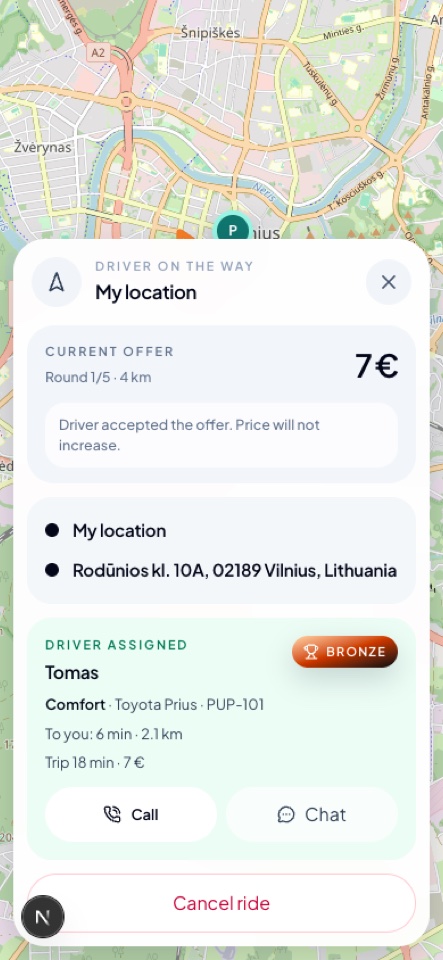
The current capture shows a demo ride state with offer, route context, assigned driver and contact actions. The useful signal is that operational roles and status need to be legible before marketplace spend.
Current demo capture used to show request status, route context, driver assignment and contact actions.
Marketplace-style customer and driver product screen with map, status, support and admin-control concern.
Ride state, offer card, route context, driver assignment, contact actions and cancellation action.
A client marketplace should prove one role-to-status loop before adding growth, pricing or extra dispatch rules.
A buyer should still ask which customer, driver, admin, payment-hold and support evidence applies to their operation.
If your product has customers, operators and admins, the concern is role confusion: nobody trusts the workflow when state and ownership are unclear.
Look for role clarity, status logic, support flows and admin control before spending on acquisition or extra marketplace features.
The reusable skill is making an operational flow legible enough for real people to request, accept, update and resolve work.
This example supports product repair and MVP builds for booking, delivery, pickup, logistics and local service marketplaces.
Pavezk should help a buyer decide whether the first safe move is product repair, product audit or an operational MVP build.
The useful signal is not a marketplace label. It is that customer, operator, driver, admin, status and ownership concern can be treated as product architecture before scale.
Best fit when customers, operators, drivers, admins or support people need one legible workflow before acquisition spend makes sense.
Role confusion, unclear status changes and weak admin control can break an operational MVP faster than missing secondary features.
If the product exists but users, statuses, support and admin control are unclear, repair the workflow before rebuilding or marketing it.
If your project has customers, operators, drivers, admins, statuses or support handovers, use this example to explain the operating question.
Use the live site as evidence of marketplace direction and public presence.